For office managers, IT directors, and procurement teams, managing printing expenses is a balancing act between operational reliability and budget discipline. Among the largest recurring line items in any office supply budget is consumable hardware—specifically toner cartridges, imaging drums, fusers, and waste boxes.
When it comes time to reorder, procurement managers face a classic choice: pay full manufacturer price for Original Equipment Manufacturer (OEM) supplies, or opt for compatible aftermarket alternatives.
However, evaluating toner costs based strictly on the upfront purchase price can lead to inaccurate budget forecasts. To understand true cost efficiency, teams must analyze cost-per-page (CPP) metrics, yield reliability, and overall fleet longevity.
Understanding the True Cost-Per-Page (CPP)
Calculating the true cost of a toner cartridge requires looking beyond the price tag on the invoice. The fundamental formula used by procurement professionals is:
Scenario A: High-Yield OEM Cartridge
-
Purchase Price: $180.00
-
Rated Yield: 10,000 pages
-
Base CPP: $0.018 per page
Scenario B: Premium Aftermarket Cartridge
-
Purchase Price: $85.00
-
Rated Yield: 10,000 pages
-
Base CPP: $0.0085 per page
On paper, the aftermarket option cuts consumable expenses by over 50%. For a company printing 50,000 pages per month across a multi-device fleet, that difference translates to several thousand dollars in annual savings.
However, realizing those savings requires ensuring the aftermarket hardware meets strict manufacturing tolerances.
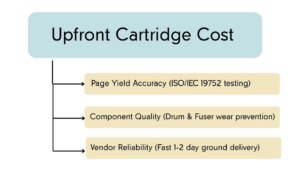
3 Critical Factors in Aftermarket Procurement
1. ISO Page Yield Testing
Not all compatible cartridges are manufactured equally. Reputable aftermarket suppliers test cartridges under standardized ISO/IEC 19752 testing guidelines. Unverified, bargain-bin cartridges often fail to meet rated page yields, eroding calculated cost savings through premature exhaustion.
2. Component Protection & Toner Quality
Subpar toner powder can lead to uneven fusing, excessive waste powder accumulation, and premature wear on critical machine components like drum units and fuser rollers. High-grade compatible toner uses precisely sized polymer particles that melt at the correct temperature, protecting internal hardware.
3. Supply Chain Lead Times & Storage
Holding excessive backup inventory ties up operating capital, while running completely out of toner halts business operations. The ideal procurement strategy relies on a supplier with multi-region distribution hubs capable of delivering replacement hardware in 1 to 2 business days.
Building a Balanced Procurement Strategy
Many enterprise fleets adopt a hybrid procurement model: utilizing OEM supplies for high-volume color graphics and executive marketing production, while deploying high-grade compatible cartridges across general office monochrome workflows.
Since 1973, Copier Supply Store has provided procurement teams with both genuine OEM and rigorously tested compatible consumables—backed by our national 6-warehouse distribution network.
Need Guidance on Fleet Consumables?
Whether you need OEM assurance or certified cost-effective compatibles, our technical team helps you select the right supplies for your specific copier model.