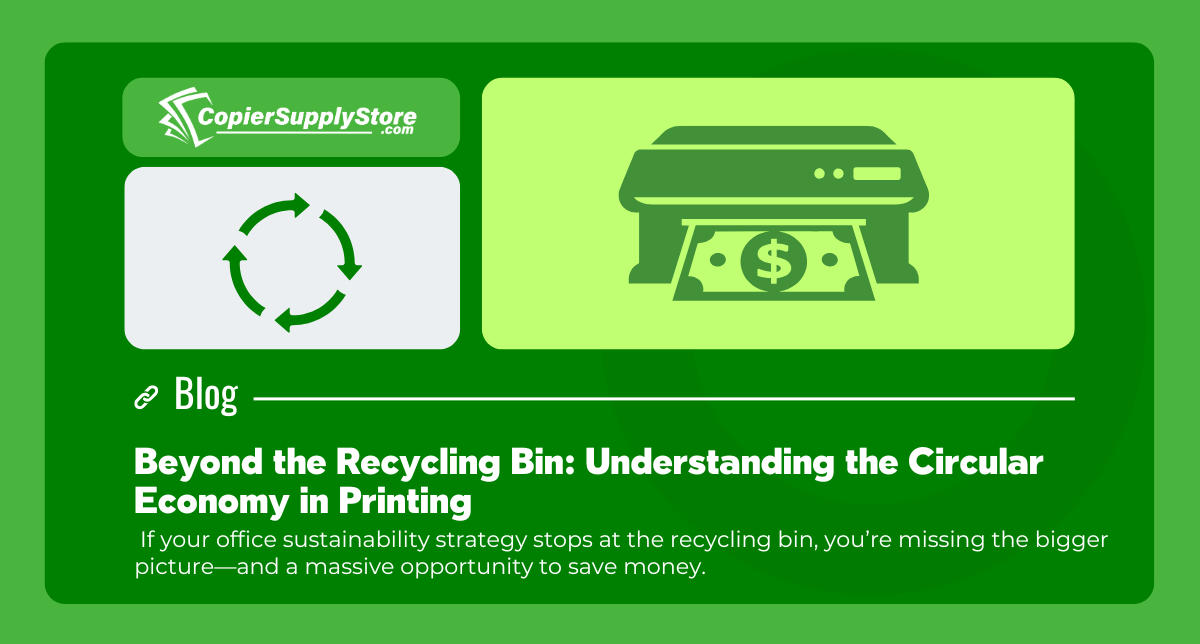
Beyond the Recycling Bin: Understanding the Circular Economy in Printing
Let’s get real for a second. We’ve all done the “recycling shuffle.” You know, that moment where you’re holding an empty toner cartridge, staring at the blue bin, and wondering, “Can I actually put this in here, or am I just wish-cycling?”
It’s a valid question. And honestly, while recycling is great, it’s kind of the bare minimum. If your office sustainability strategy stops at the recycling bin, you’re missing the bigger picture—and a massive opportunity to save money.
Welcome to the circular economy. It sounds like a fancy buzzword that people in turtlenecks use at conferences, but it’s actually a super simple concept that can revolutionize your supply closet. Instead of the old “buy it, use it, toss it” routine, a circular model keeps resources in use for as long as possible.
And for your printer fleet? It’s a game-changer.
The Problem with “Take-Make-Dispose”
Most offices run on a linear economy. You buy a brand-new, petroleum-heavy plastic cartridge. You print your reports (and maybe a few personal concert tickets—we won’t tell). The toner runs out. You throw the cartridge away. Repeat.
This “take-make-dispose” model is… well, it’s trash. Literally.
Every time you buy a net-new cartridge, you’re paying for raw materials, manufacturing energy, and shipping weight that eventually just ends up in a landfill. Even if you recycle it, the energy required to break it down and make something new is significant.
We can do better. Your budget definitely wants you to do better.
What is the Circular Economy in Printing?
Think of the circular economy as the ultimate “reduce, reuse, recycle” glow-up. In the printing world, this primarily means embracing remanufactured cartridges.
These aren’t those sketchy “drill-and-fill” jobs from twenty years ago that exploded black dust all over your khakis. Legitimate remanufacturing is a high-tech engineering process.
Here’s how the loop works:
- Collection: Empty cartridges are collected (instead of landfilled).
- Disassembly & Cleaning: They are taken apart, inspected, and thoroughly cleaned.
- Restoration: Worn parts are replaced with high-quality components.
- Refilling: The cartridge is filled with premium toner that matches the original specs.
- Testing: It gets tested to ensure it prints just as well as a “new” one.
The result? A product that looks new, works like new, but didn’t require drilling for fresh oil to create the plastic shell.
Why “Reman” is the MVP of ESG Goals
If your company has ESG (Environmental, Social, and Governance) goals, your printer is the easiest place to score a quick win.
Trees are a vibe, right? Well, choosing remanufactured cartridges over new ones is one of the most impactful things you can do for them.
1. The Carbon Math Doesn’t Lie
Manufacturing a single new toner cartridge requires oil—about three quarts of it. That adds up fast. By reusing the existing plastic shell and components, remanufactured cartridges have a 46% lower carbon footprint than new ones.
That is nearly half the environmental impact for the exact same output. If you could cut your electricity bill by 46% without turning off the lights, you’d do it in a heartbeat. Why treat your carbon footprint differently?
2. Keeping Plastic Out of Landfills
It takes hundreds of years for a plastic cartridge to decompose. By supporting the remanufacturing loop, you are actively diverting waste from landfills. You’re not just buying a product; you’re buying a solution to the waste problem.
3. Conserving Raw Materials
It’s not just about plastic. Cartridges contain steel, aluminum, and rubber. Remanufacturing recovers these materials, meaning we don’t have to mine or process new raw resources. It’s efficient, it’s smart, and frankly, it’s how all manufacturing should work.
The “But Will It Break My Printer?” Myth
We hear this all the time. “I want to be green, but I don’t want a paper jam at 4:55 PM on a Friday.”
We get it. The trauma of a broken printer is real. But here’s the truth: High-quality remanufactured cartridges are reliable.
The “compatible” or “reman” industry has come a long way. Reputable suppliers (hi, that’s us) use automated manufacturing lines and rigorous quality control testing. We’re talking about products that meet or exceed OEM (Original Equipment Manufacturer) standards.
You get the reliability you need to keep the office manager happy, without the environmental guilt.
Saving the Planet (and Your Budget)
Here’s the best part. Sustainable usually means “more expensive,” right? Not here.
Because remanufacturers aren’t building the plastic shell from scratch, the production costs are lower. Those savings get passed on to you. You can typically save 30-60% on your supply budget just by switching from OEM to remanufactured.
Lower costs. Lower carbon footprint. Same print quality.
It’s rare in business that you get a “win-win-win” scenario, but this is one of them.
How to Start Your Circular Journey
You don’t need to overhaul your entire office overnight. Start small.
- Audit your current stock. Are you buying 100% new OEM cartridges?
- Test a switch. Try a high-quality remanufactured cartridge for your main workhorse printer.
- Check the math. Compare the cost and see the savings for yourself.
- Recycle the rest. Make sure you have a program in place to return your empties so they can re-enter the cycle.
The circular economy isn’t just a trend; it’s the future of efficient business. It’s about being smarter with what we have.
So, go ahead. Be the office hero who saved the budget and the planet. We won’t even make you wear a cape (unless you want to).
Ready to make your supply closet a key part of your sustainability strategy?
Explore our line of eco-friendly, remanufactured cartridges and start saving today.
]]